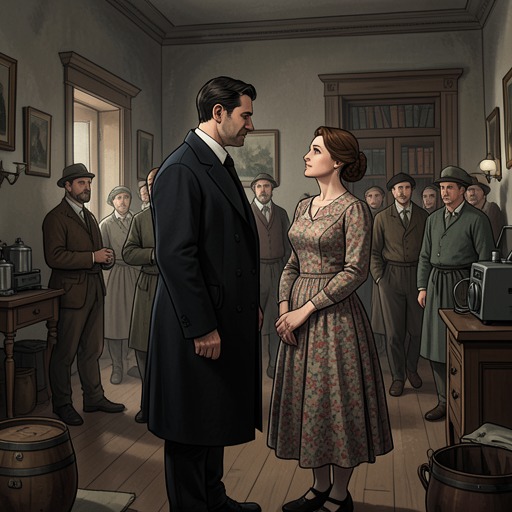
Martin asks Ruth for guidance on his education
Martin EdenMartin Eden asks Ruth Morse for guidance on his education in a conversation that turns his desire to enter a cultivated world into a practical question of where to begin. He describes the distance between the books and household he admires and the life he has known, then discovers that Ruth’s advice about grammar opens a revealing exchange: as she teaches him, he shows that he can test a rule rather than merely accept it.
The Request and Its Stakes
The question begins with Ruth trying to work out how to help him, but Martin reaches the subject first. He asks whether he can get advice, explaining that since his previous visit he has spent much time at the library and tried books he could not understand. Rather than pretending that effort has already made him educated, he admits that he may have been reading the wrong kind of material and asks where to take hold and begin. The request is both practical and exposed: he seeks instruction from Ruth, while acknowledging that he does not know how to talk about books and learning in her terms.
Martin explains the distance he has traveled through reading. The books available in cattle camps and forecastles were not like the books in the Morse home, but he insists that he had always liked books and read whatever he could find. He does not claim superiority over the sailors and cow-punchers he had lived among; instead, he says that he thinks differently from many of them. His account makes self-education a continuation of an existing appetite, not a sudden pose adopted to impress Ruth.
The house gives that appetite a vivid object. Martin recalls seeing the books, pictures, and beautiful things there, and wanting the kind of life they seemed to represent: clean surroundings, quieter conversation, and thoughts not confined to food, rent, quarrels, and drink. He remembers Ruth crossing the room to kiss her mother as one of the most beautiful things he had seen. The gesture matters because his wish is not limited to acquiring facts or correcting his speech; he is drawn to a whole domestic and cultural world that he has previously encountered largely through books.
A Desired Life Without a Clear Route
Martin frames his aim as reaching the kind of life he has seen in Ruth’s home. He says that life must hold more than drink, hard work, and constant movement, but cannot yet identify the first step toward something else. His offer to work night and day establishes his confidence in endurance even as he lacks a plan for using it. The contrast is sharp: he believes himself capable of immense labor, yet the education he wants appears to require knowledge of routes and institutions he has never had the chance to acquire.
He also recognizes the awkwardness of asking Ruth. He says he does not know whom else to approach, except perhaps Arthur, and breaks off as the possibility makes him feel he may have made a fool of himself. Ruth’s response is shaped by the contrast between his halting, uncouth speech and the power she perceives in him. Her hesitation before answering marks a gap between what his language seems to indicate and what she senses his capacity might be; she reads strength in the very effort of a mind straining against its limits.
Ruth’s Prescription and Martin’s Circumstances
Ruth identifies education as the need Martin has already recognized. Her first prescription is formal and sequential: he should return to finish grammar school, then continue through high school and university. Martin immediately raises the obstacle she has not considered: money. When Ruth asks whether relatives could assist him, he explains that his parents are dead and that his siblings will not help. He has two sisters, one already married and the other expected to marry, and several brothers scattered across the world; he describes them as people who look after themselves.
His family history makes self-teaching less a preference than the only route he can see. Martin says he has taken care of himself since he was eleven, when his mother died, and that he expects he must study alone. He gives specific glimpses of his brothers’ dispersed lives: one died in India, two are in South Africa, another is on a whaling voyage, and one travels with a circus as a trapeze performer. The account explains why Ruth’s school-to-university plan cannot simply be followed as offered. Martin is not refusing education; he is asking how to pursue it without the support her recommendation assumes.
Grammar as a Test of Understanding
Ruth turns the problem toward an immediate lesson. She proposes that Martin begin with a grammar and softens her initial judgment of his English, revising her intended description of it as awful to the more qualified observation that it is not particularly good. Martin flushes and sweats, aware that his speech contains slang and words Ruth may not understand. He distinguishes this spoken limitation from his thoughts: he has picked up other words from books but cannot pronounce them, so he does not use them.
Ruth illustrates his errors with the difference between “You was” and “You were,” and between “I seen” and “I saw,” then introduces the double negative. When Martin asks what that means, she explains it through his description of his brothers as having “never helped nobody.” Her account invokes a rule that two negatives make a positive, so that the phrase would imply they had helped somebody. Martin says he understands, but does not accept the explanation uncritically: the phrase, he argues, simply fails to say whether they helped anybody. He concludes that he will not use it again.
The exchange changes the balance of the lesson. Ruth is the one with formal education and the authority to name grammatical rules, but Martin’s response shows how rapidly he can grasp a principle and examine whether its stated consequence makes sense. Ruth is pleased and surprised when he not only understands the explanation but catches its flaw. The scene thus presents his educational disadvantage concretely, in his grammar and pronunciation, while refusing to equate those disadvantages with an inability to reason. His request for guidance reveals a learner in need of access and instruction; his correction reveals that he already brings an independent, questioning intelligence to the work.